
Every major streaming service now sells the moment you hit pause. Hulu started it in 2019, Peacock shipped with it in 2020, Netflix and Prime Video and YouTube all arrived in 2024, and as of this year the IAB Tech Lab is writing guidelines for it. Six years from one company's experiment to a line item in everybody's upfront.
The format is also the most over-marketed thing in connected TV right now. Nearly every number you will read about pause ads has been through three or four blog posts before it reached you, and a surprising amount of it does not survive being looked up. One widely-quoted statistic appears to have no findable study behind it at all. Another one, the one that underpins most of the industry's confidence that viewers actually like this format, is eight people on a video call in 2021.
We build streaming products, and we built pause ad serving into one of our own apps this year, so this article is written from the supply side. What the format is, what one looks like in a real player, what every platform's specs are in one table, what the honest evidence says, and what it actually takes to serve one.
What is a pause ad?
A pause ad is a still image advertisement that fills the screen when a viewer pauses a streaming video. It appears a few seconds after the pause, stays until playback resumes, and carries no audio and no video. Most run on connected TV, where the viewer paused with a remote.
The IAB Tech Lab, which is currently trying to standardise the thing, defines it as "a TV ad experience initiated when the viewer uses a remote to pause the content being watched." That definition is carrying more weight than it looks. The viewer initiated it. Nobody interrupted anything.
That is the entire pitch and it is a genuinely good one. A pre-roll takes time the viewer wanted to spend watching, which is why viewers hate pre-rolls. A pause ad takes a screen the viewer was about to abandon anyway, because they got up to answer the door. The industry calls this non-interruptive, which for once is marketing language pointing at a real distinction.
One disambiguation before we go further, because two different things share this name and Google cannot tell them apart either. If you are here to find out how to stop a campaign from spending in Meta Ads Manager or Google Ads, that is pausing an ad, and it is a toggle next to the campaign name. This article is about the pause ad as a creative format on television.
What a pause ad actually looks like
Here is one, screenshotted from the My TV Channel player on iOS. Not a mockup, not a media-kit render.
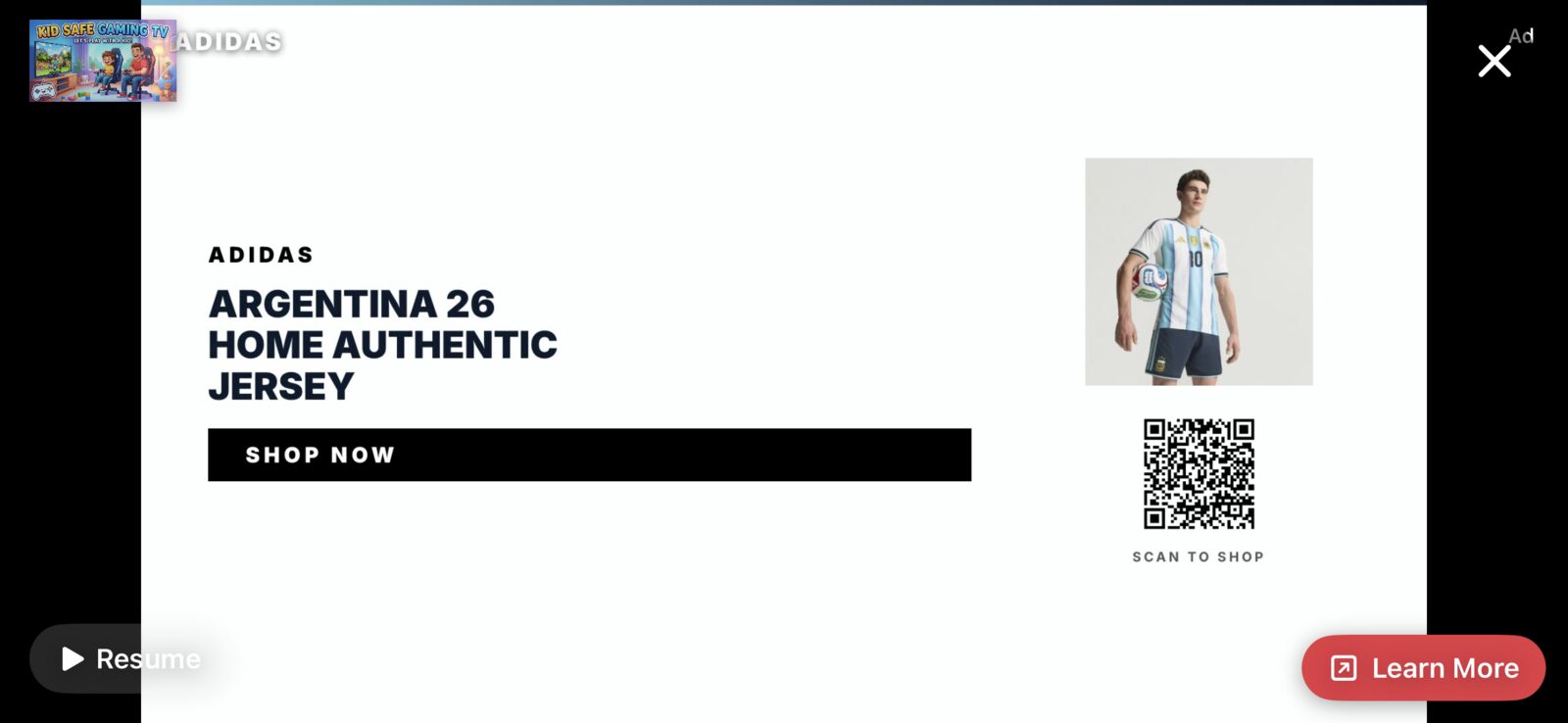
A pause ad in the My TV Channel player on iOS. The creative was generated from a product page URL by our free AI Ad Generator as a demonstration, and is not a paying advertiser's campaign.
The creative is the boring part. The interesting part is the chrome the player wraps around it, because that chrome is most of what the format actually is.
There is an Ad label, which is not decoration. A viewer has to be able to tell an advertisement from the programme without thinking about it, and that is a regulatory position as much as a design one.
There is a close button, which in this player means what it means everywhere else in this player: leave. It does not mean dismiss the ad.
Which is exactly why there is a Resume pill. Once your close button means leave, the viewer who wants their show back has no obvious way to get it, and an ad you cannot escape is a worse ad than no ad. This is the kind of thing you only discover by building one.
There is a QR code baked into the creative, and this is the part that makes pause ads commercially interesting rather than merely tolerable. On a television there is nothing to click. But the viewer who just paused is almost certainly holding the one device in the room that can scan.
And there is a Learn More button for the platforms where a tap is actually possible.
The creative itself is a silent still. No sound, no motion. That constraint is not a technical limitation. It is a research finding, and it comes from the company that invented the format.
Where pause ads came from
Hulu announced the pause ad in December 2018 and unveiled it properly on 31 January 2019, launching that spring. The first two brands to run it were Coca-Cola and Charmin.
The useful part is the research Hulu did beforehand. Jeremy Helfand, then Hulu's head of ad platforms, put it about as plainly as anyone in this industry ever puts anything: "Viewers were strongly against it being a video format."
So the pause ad shipped as a semi-transparent, non-video banner appearing five seconds after you paused, and Hulu kept it off TV-MA episodes and live TV entirely. The company said at the time that it wanted half its ad revenue coming from non-disruptive formats within three years, back when it had 25 million subscribers. Read that sentence again, because it explains most of what has happened in CTV advertising since.
Everyone followed:
| When | What happened |
|---|---|
| Jan 2019 | Hulu unveils the pause ad. Launches Q2 2019 with Coca-Cola and Charmin. |
| Apr 2020 | Peacock launches on 15 April with pause ads from day one. |
| 2022 | Max adds the format. |
| 2023 | YouTube begins piloting pause ads on connected TV. |
| May 2024 | Netflix starts a pause ad beta. Prime Video announces interactive and shoppable pause ads at its upfront. |
| Sep 2024 | YouTube opens pause ads to all advertisers. |
| May 2025 | Fubo becomes the first CTV platform with programmatically biddable pause ads, via Magnite. |
| Aug 2025 | Magnite extends programmatic pause ads to DirecTV and Dish Media. |
| Feb 2026 | Twitch begins testing pause ads. |
The second public comment period on the IAB Tech Lab's Ad Format Guidelines for Digital Video and CTV v2, which covers the pause ad, closes on 16 July 2026. Pause is one of the six CTV ad formats the IAB is standardising, and one of the first two prioritised for programmatic support. Standardisation is the live storyline in this format right now, and the reason why is further down in the pricing section.
Pause ad specs, platform by platform
Every platform publishes its own spec sheet and none of them reference each other, which is why nobody has this table. Everything below is from first-party documentation. Where a platform does not publish a number, the cell says so instead of guessing.
| Platform | Appears after | Creative | How you buy it |
|---|---|---|---|
| YouTube (CTV only) | 10 seconds | Static image, 1080-1350px wide, PNG or JPG, 2MB max, headline 70 characters max | Reservation only. 35 countries. |
| Prime Video | Not published | 1920x1080 min, 3840x2160 recommended. Copy 86 characters max, legal 180, 24px min font, 4.5:1 min contrast, QR 196x196 | Direct. Interactive and shoppable variants since May 2024. |
| Disney+, Hulu, ESPN | 5 seconds (Hulu at 2019 launch) | 1085x770 transparent PNG. No solid backgrounds, no Disney UI elements. | Direct. 12 business days turnaround. |
| Peacock | More than 5 seconds | Full screen takeover | Direct. |
| Roku Channel | Not published | Not published | Direct I/O, programmatic, or Roku Ads Manager. 2 weeks turnaround. Roku Channel only. |
| Paramount | "A few seconds" | 1920x1080 | Direct. |
Two things fall out of that table.
The first is that the delay is not standard and nobody agrees on it. YouTube makes a viewer wait twice as long as Hulu did. There is no published research justifying either number, and the gap between them is the whole argument about whether a pause ad is a courtesy or an interruption.
The second is the turnaround column. Twelve business days at Disney. Two weeks at Roku. For one static image. Whatever is happening in those two weeks, it is not rendering.
How pause ads work technically
The format sounds trivial. Viewer pauses, show picture. We built pause ad serving into the My TV Channel player this year and the two hard parts are not the ones you would guess.
Knowing that a pause is a real pause
A video player reports itself as paused for all sorts of reasons that have nothing to do with a human pressing a button. Ours pauses itself to swap the stream when recovering from a network stall, and on a live playlist it can sit in that state for several seconds. Hang your ad trigger off the naive signal and you fade an advertisement over a viewer whose stream just broke, then bill somebody for the impression. We had to suppress those explicitly.
The same trap catches you from the other side. If you track your own intent (a flag you set when the user taps your pause button) rather than the player's actual state, you miss every pause the system initiated. The viewer who paused from Control Center. The one who unplugged their headphones. The phone call that came in. Those are all real pauses, and the viewer is really sitting there looking at a frozen frame.
On Apple platforms this means observing timeControlStatus rather than trusting your own boolean, and then filtering out your own recovery pauses on top of that. It is about thirty lines of code and it is the difference between a working pause ad and a stream of garbage impressions.
Timing
Our player waits 600 milliseconds before it shows anything, and cancels if playback resumes first. Somebody who taps pause and immediately taps play was adjusting something, not taking a break, and should never see an ad at all. Once the ad is up, it must stay visible for 800 milliseconds before we count an impression.
We count one impression per creative per playback session, not per display. A viewer who taps pause and play ten times has seen one ad. Any other choice quietly inflates the only number this format produces.
That last point deserves more attention than it gets. If you buy pause ads, ask the platform whether their impression count is per display or per session. Nothing in any published spec sheet answers this, and on a fidgety viewer the difference is a factor of ten. It is the easiest place in CTV for a number to be technically true and practically meaningless.
Privacy
Our impression beacon carries no viewer identifier. None at all. That is deliberate rather than lazy: it is what keeps the format out of tracking territory under Apple's App Tracking Transparency rules, and it is why frequency capping has to happen on the device instead of the server. You give up per-user reporting. In exchange you get an ad format that never needs a consent prompt. For a format whose entire selling point is that viewers do not mind it, that trade is worth making.
Are pause ads effective?
Probably. But almost every number you will read on this topic has been laundered, so here is the working.
Numbers that hold up
NBCUniversal, December 2023. Peacock's own case study reports a 41% increase in ad memorability against a standard mid-roll, and that 66% of pause events run longer than 60 seconds among adults 18 to 49. The methodology footnote is specific: long-form VOD, ten-foot devices only, pause events under 5 seconds excluded, fast-forward and rewind excluded, durations capped at 600 seconds. That is a real measurement of a real thing, and it is the best single number in this format.
Wunderkind Ads with OpenGlass, measured by TVision, June 2026. Pause ads drew 69% more attention than a traditional 60-second CTV spot, across 13 verticals. Automotive was the outlier at 34.2 seconds against 12.2.
Magna and DIRECTV, 2025. 91% of people pause streaming content at least sometimes. 54% of pauses last one to five minutes. Between 60% and 67% of viewers, depending on generation, would rather see a pause ad than a frozen screen. Worth knowing that DIRECTV sells pause ads and sponsored the write-up.
Index Exchange, June 2026. Roughly two thirds of surveyed streaming publishers are live with or testing pause ads, and 80% of agencies and DSPs expect to increase pause ad spend next year. The survey does not disclose how many people it asked.
Numbers to handle carefully
The eight-person study. That same NBCUniversal case study contains the quotes about viewers finding pause ads acceptable and unobtrusive, and those come from qualitative research the document itself sources as n=8, conducted over virtual one-on-one interviews in Q3 2021. Eight people. A good part of this industry's confidence that viewers like this format traces back to eight people on a video call five years ago. The measured 41% memorability figure is solid and we cite it above. The "viewers love it" narrative built on the same PDF is eight people, and it is repeated everywhere without the footnote.
"Nearly twice the attention." The Wunderkind result got reported that way across the trades. The actual figure across all 13 verticals is 69%. The two-times number only holds in the strongest categories. Both are good results. Only one of them is the headline.
"51% of viewers take action after seeing a pause ad." Attributed to the Video Advertising Bureau, repeated by more or less every page on this topic. We went looking for the underlying study: the sample, the year, the definition of "action". We could not find it. If you can, send it to us and we will link it here and correct this paragraph.
"91% aided brand recall, 98% message recall, 24-second average dwell, 100% viewability." From a TripleLift and MediaScience eye-tracking study. These are currently the numbers Google itself surfaces when you ask whether pause ads are effective. No sample size published, no date, no methodology. TripleLift's own blog elsewhere says 92% rather than 91%, which tells you roughly how much care these numbers are getting on their way around the internet.
The 41 versus 43 muddle. NBCUniversal's PDF says 41% memorability. Various write-ups attribute 43% memorability to NBCUniversal, a separate 43% to a FreeWheel and TripleLift study, and a 43% lift in site visitation to NBCUniversal again. These are different claims from different studies being blended into one statistic. If you see 43% next to NBCUniversal's name, somebody copied it wrong.
None of this means pause ads do not work. The Peacock memorability result and the TVision attention measurement are both real, both methodologically legible, and both point the same way. It means the evidence base is thinner than the marketing, which is true of most ad formats and is never admitted by anyone selling one.
What pause ads cost
Nobody knows yet, and that is the honest answer.
Index Exchange surveyed the market in June 2026 and found the gap: buyers expect to pay under a $15 CPM. Publishers value the inventory at $15 to $25 or higher. That is not a price. That is a bid/ask spread, and it is what a market looks like before it has settled.
The reason it has not settled is in the same survey. 70% of buyers named the lack of standardisation as the main obstacle. Every platform has its own dimensions, its own delay, its own definition of an impression, and its own multi-week human review queue. You cannot run one creative across six services, so you cannot buy at scale, so the price stays argued about. This is precisely the problem the IAB Tech Lab's guidelines exist to fix, which is why a comment period closing in July matters more than a comment period usually does.
The case against pause ads
Every vendor page on this topic skips this section, which is why it is the most interesting one.
Start with who pauses, and why. The industry framing is that the viewer walked away, so the screen is free inventory. But some people pause constantly and are watching more closely than anyone. From a Roku user, on hearing the platform was considering more pause advertising: "I am hard of hearing and pause often to read captions."
Pausing to re-read a line. Pausing to catch a name. Pausing to look at something on screen. These are not moments of absence. They are moments of unusually close attention, which is exactly why they look so good in an attention study, and selling them is a materially different transaction from the one described in the decks.
Then there is the trust problem. In May 2025 a rumour went around that Roku was going to show pause ads over HDMI inputs, meaning over your games console. Roku publicly denied it, and the denial was true. But the rumour travelled as fast as it did because it was instantly plausible to a lot of people, and that reaction is itself a data point about where this format's goodwill sits. The Reddit thread on streamers pushing pause ads harder runs to nearly 400 comments and it is not warm.
Buyers are not uniformly sold either. Agency people have questioned the recall figures on the record, which is unsurprising when you notice how few of those figures ship with a sample size.
Our own read: the pause ad is genuinely better for the viewer than a pre-roll, which is a low bar it clears easily. It stops being better the second somebody decides that if a pause is worth one ad, every pause is worth an ad. The property that makes a pause ad tolerable is that the viewer caused it. That property does not survive being maximised, and the entire history of digital advertising suggests somebody is going to try.
Serving pause ads as a publisher
Everything written about pause ads is written for the advertiser buying them or the platform selling them. Almost nothing is written for the person running the channel. So, briefly.
A pause ad needs three things: a player that can tell a real pause from a stall, a still image, and a way to count that it was shown. That is a smaller technical problem than most of what running a channel involves, and considerably smaller than the SSAI stack you would need for a mid-roll. There is no manifest manipulation, no ad-stitching, no transcode. It is an image and an HTTP call.
The hard parts are commercial. You need advertisers, and you need to be certain each one has the right to the brand in their creative.
On My TV Channel, pause ad serving is built into the player on iOS, iPadOS and macOS today. Free-to-air channels can carry advertising and the platform takes 0% commission, so the ad revenue goes to whoever runs the channel. Paying subscribers never see an ad. Apple TV, Android, Roku and Fire TV are not wired up for the format yet.
Make the creative
Paste a product or service page URL into the AI Ad Generator and you get a finished video ad plus a pause ad still, in about 15 to 35 minutes. The first one is free, with no login and no credit card: a watermarked 9:16 preview and a clean, never-watermarked pause still. Removing the watermark starts at $8.
When the job finishes you can reserve a free pause ad slot on My TV Channel, choosing a country and a language. Every reservation is reviewed before anything runs, so a reserved slot is a queue position rather than a booking.
See it running
My TV Channel is free on iPhone, iPad, Apple TV and Mac. Watch 24/7 channels, or create your own and run it free-to-air with advertising.
FAQ
What is a pause ad?
A pause ad is a still image advertisement that fills the screen when a viewer pauses a streaming video. It appears a few seconds after the pause, stays until playback resumes, and carries no audio and no video. Most run on connected TV, where the viewer paused with a remote.
Are pause ads effective?
The evidence is real but thinner than the marketing. NBCUniversal measured a 41% increase in ad memorability against a standard mid-roll on Peacock. Wunderkind Ads, measured by TVision in 2026, found 69% more attention than a traditional 60-second CTV spot across 13 verticals. Both are vendor-published. The widely-quoted 91% brand recall figure ships with no sample size and no date, and the equally common claim that 51% of viewers take action traces back to a Video Advertising Bureau study that does not appear to be publicly available.
Do pause ads have sound?
No. Pause ads are silent still images. When Hulu researched the format before launching it in 2019, viewers were strongly against a video pause ad, so it settled on a quiet static image that does not compete with the room the viewer just walked into.
How much do pause ads cost?
There is no settled price. An Index Exchange survey published in June 2026 found buyers expect to pay under a $15 CPM while publishers value the format at $15 to $25 or higher. That gap is the story: 70% of buyers named the lack of standardisation as the main obstacle to spending more.
How long after pausing does a pause ad appear?
It varies by platform. YouTube waits 10 seconds. Hulu waited 5 seconds at launch in 2019. Peacock triggers after a pause runs longer than 5 seconds. Paramount says only a few seconds. The delay exists so that a viewer who pauses to adjust the volume and immediately resumes never sees an ad at all.
What does "pause ad" mean on Facebook, and how do I pause an ad campaign?
Different subject, same words. Pausing an ad campaign means stopping delivery and spend on a campaign you are running in Meta Ads Manager, Google Ads or a similar tool, usually with a toggle next to the campaign name. This article is about the pause ad as a connected TV creative format.
Can a small channel run pause ads?
Technically yes, and the barrier is lower than it looks: a player that can tell a real pause from a buffer, a still image, and a way to count that it was shown. No SSAI, no manifest manipulation. The hard parts are commercial, because you need advertisers and you need certainty that each one has the right to the brand in their creative.
Sources
- Hulu, "Hulu Unveils New Pause Ad Experience", 31 January 2019. Launch date, Coca-Cola and Charmin, the 5-second delay.
- Digiday and TechCrunch, 31 January 2019. The Helfand quote, the non-disruptive revenue goal, the TV-MA exclusion.
- NBCUniversal, Pause Ad Innovation Case Study (PDF), December 2023. The 41% memorability figure, the 66% of pauses over 60 seconds, and the n=8 source line.
- Index Exchange, "Streaming TV pause ads are ready to scale if the industry can standardize", 18 June 2026. CPM expectations, the standardisation obstacle, publisher and buyer intent.
- TV Tech on Wunderkind Ads, OpenGlass and TVision, June 2026. The 69% attention figure and the vertical breakdown.
- eMarketer and Digiday on the Magna and DIRECTV study, July 2025. Pause behaviour and duration. Sponsored by DIRECTV.
- IAB Tech Lab CTV Ad Portfolio. The format definition and the guidelines under public comment.
- Platform specs: Google Ads Help (YouTube), Amazon Ads (Prime Video), Disney Advertising, Roku Advertising, Paramount.
- The Desk, May 2025. Roku's denial of the HDMI pause ad rumour.
If a figure here is wrong, or you can point us at that Video Advertising Bureau study, tell us and we will fix it.