What is MLVC (Machine Learning Video Codec)?
MLVC stands for Machine Learning Video Codec. Microsoft released it as open source in July 2026 under the MIT licence, and it is the product version of the DCVC (Deep Contextual Video Compression) research line that Microsoft Research has been publishing since 2021.
A conventional codec like H.264 or H.265 is assembled from hand-designed parts: motion estimation, a transform, an entropy model, and a large pile of encoder heuristics. MLVC replaces all of it with a single neural network trained end to end against a rate-distortion target.
That has an awkward consequence. There is no bitstream specification to implement, because the trained weights are the format. Encoder and decoder have to run the same model and agree on its arithmetic almost bit for bit, which is the problem the MLVC paper spends most of its pages solving.
Where it runs. MLVC targets the NPUs already shipping in laptops and phones, meaning the Apple Neural Engine and the Intel and Qualcomm NPUs, rather than dedicated codec silicon. The full model is 18.3 million parameters and a lighter MLVC-S variant is 5.4 million. Microsoft reports real-time 540p at 30 fps on all three vendors while using no more than half of the NPU.
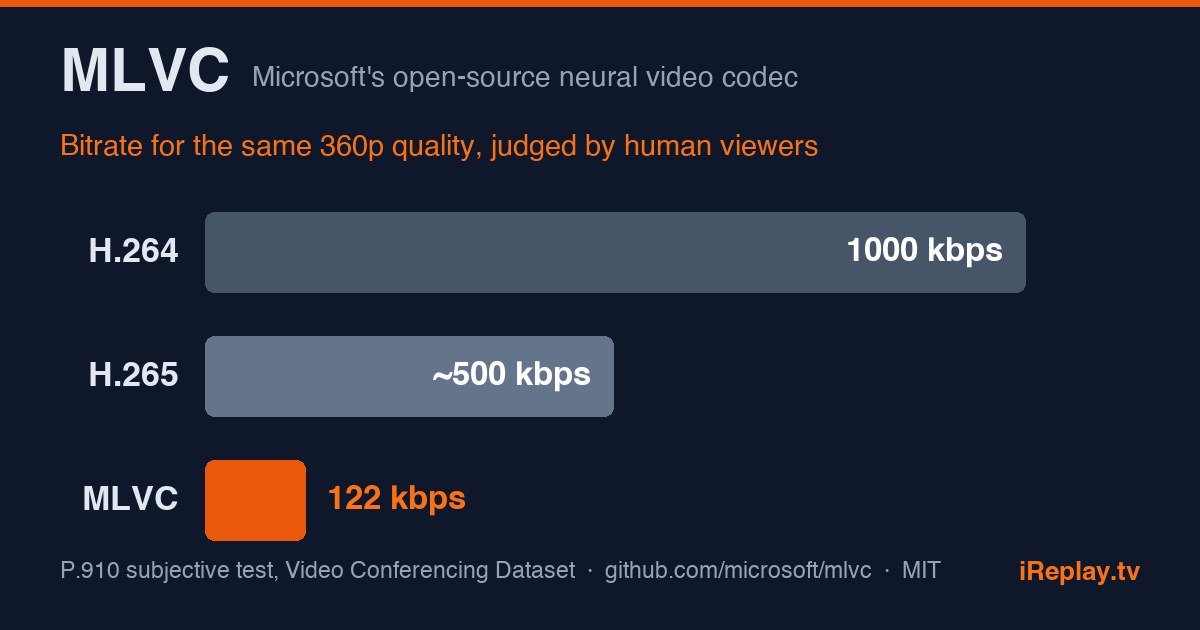
What it saves. On Microsoft's video conferencing test set, scored by human viewers under ITU-T P.910, MLVC needs 87.8% less bitrate than H.264 and 75.5% less than hardware H.265 at 360p. At 540p it is 82.7% and 65.4%. In practical terms, 360p video that costs 1 Mbps in H.264 costs around 122 kbps in MLVC at matching quality.
The catch. Those results come from talking-head content at low resolution, measured against hardware encoders, and playback needs a device that can run the model. No TV, set-top box or browser decodes MLVC today. Microsoft is rolling it out in Microsoft Teams for peer-to-peer calls, which is exactly the case where it controls both ends of the link. For streaming delivery it is a signal worth watching rather than something you can ship.
We went through the paper, the benchmarks and the repository in more detail here: Microsoft open-sourced a neural video codec, and what it actually means for streaming.
Need Help With Your Streaming Project?
Our network of streaming professionals can help you implement and optimize your video infrastructure.
Hire a Professional →